Alphabets;
gematric calculator
Shakespeare's
Epitaph
K. Shakespeare understands himself as Mary's Son
E. Gematric
aspects of the 4 Y-Words;
G. Y-words in the Angel's Message
to Mary
J. The Annunciation words in Greek
and Latin
L. Shakespeare's gematric
construction for Jesus and Mary
I. Two Semicircles
II. The
Five Backward-Steps of Y-Words
|
GOOD FREND FOR IESVS SAKE FORBEARE |
|
TO DIGG THE DVST ENCLOASED HEARE. |
|
BLESTE BE YE MAN YT SPARES THES STONES |
|
AND CVRST BE HE
YT MOVES MY BONES. |
I. Two Semicircles
1.
My
study on Shakespeare's Epitaph has largely dealt with the 4 Y-words, each consisting of 2 letters. I related the 4*2 letters to the word PENSATOR, and the 4 Y-words to the Greek Annunciation titles for Jesus (H)Yios (H)Ypsistou, (H)Yios T(h)eou – Son of the Highest, Son of God.
2.
There is
a curiosity of spelling and pronunciation in the first two letters of these
four words: The aspirate H is
pronounced, but not represented as a single letter. It is marked by a
semi-circle ( before the following sound with the open part looking to the
right, e.g. (Yios.
On the other hand TH is the Latin transcription for the single Greek
letter THETA (J,Q), just like in English the two letters th for the single sound [θ]. So on there are the one hand two sounds and one
letter, on the other hand two letters for one sound.
3.
Shakespeare
made use of an English printing convention to replace TH by Y and put the E above the Y.
Similarly Y plus superscript T meant THAT.
In the four Greek words mentioned above (H)YIOS is named twice. So if Shakespeare repeats YT, it's plausible to suggest that the second
letter T stands for THEOU. YE, furthermore, may stand for the first three letters of THEOU. So the first three Y-words of the epitaph can be read like this:
|
YE |
YT |
YT |
|
THEOU |
(H)YIOS THEOU |
(H)YIOS THEOU |
In this way the letter Y – as true letter Y and sign for TH – connects (H)YIOS with THEOS: Jesus is Son and God in one.
4.
Under
this assumption, i.e. amidst such theological terms, Shakespeare must have
connected some special meaning with the fourth word MY. It is distinguished from the other three words by
being written successively:
|
E |
T |
T |
|
|
Y |
Y |
Y |
MY |
If YE and YT do not have
a meaning for themselves, but represent other words, MY, by analogy, can also stand for words similar in
meaning to its preceding equals. So it's reasonable to assume that Shakespeare
was inspired by the English form MARY for MARIA to understand MY as two initials for the Latin form MARIAE YIOS – MARIA's Son. We may even suppose that it was
Shakespeare's firm intention from the beginning to honour the Virgin Mary as
his celestial protectress and that he was intrigued by the possibilities which
the possessive pronoun MY offered him.
In an earlier chapter I pointed out that the first Y-word starts, and the last ends with Y, which suggests the arrangement of the 4 words in a circle. Two arrangements are imaginable:
|
|
|
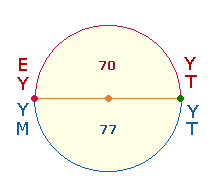
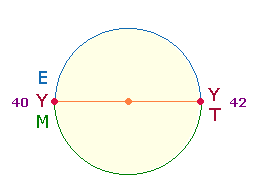
The first graphic assigns two Y-words to the beginning and end of each semi-circle.
This circular arrangement, however, is not an end in itself, but has to be
cleared of superfluous double forms so that the two semi-circles are connected
in a new way. What is left after one YT on
the right and one Y on the left has been removed reveals the
aimed at sense that was not recognisable before. If the reading starts on the
right (YT), the the 2+3 letters can be understood as initials for YIOS THEOU and MARIAE YIOS in such a way that YIOS is enclosed by the first and last letter of the
genitive case MARIAE.
The meaning of this enclosure is
protection: Jesus was protected in Mary's womb before he was born. When Jesus
hung on the cross, he said to his mother, referring to his disciple John:
"Woman, this is your son", and to the disciple "This is your
mother". So all Christians can look upon Mary as their mother, who
protects them like her own son Jesus. In the Middle Ages Mary came to be
venerated as "Madonna of the Protecting Cloak" (Schutzmantelmadonna):
|
|
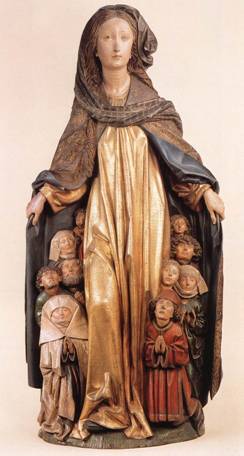
The Virgin Mary is the bridge through which
the Son of God entered human history in order restore
the wounded creation. We may imagine, in the way of the represented circle,
that Adam and Eve after disobeying God's commandment, were excluded from the
upper half of the circle that represented light and happiness and henceforth
had to live in the lower half, in a world of remoteness from God and many forms
of deprivation.
5.
The NS 42 and 40 of YT and MYE can be put
in the ratio 2*(
|
|
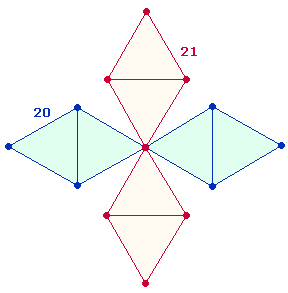
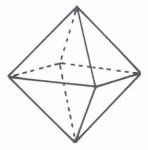
The two octahedra can be thought to
represent the two expressions YIOS THEOU and YIOS YPSISTOU and, in a theological sense, the divine
and the human nature of Jesus Christ.
6.
If MY stands for the MARIAE HYIOS, then the English form MARY with the Y at the end can be understood in the same way. The
numeric values of MY and MARY are the inverted numbers 35 and 53, which are
half the NV and the NV+FV of IESUS (70, 106).
If the genitive M-E means M-ARIA-E, then ARIA can be equated with Y and YIOS. The 4values of ARIA prove to be the NS 74 of WILLIAM:
|
|
NS |
FS |
sm |
FV1 |
FV2 |
sm |
tot. |
|
ARIA |
28 |
25 |
53 |
11 |
10 |
21 |
74 |
1.
We can
distinguish four groups of words and five steps until the final goal of sense
is reached, two concerning the text (T) and
three the circle (C):
|
T
1. |
YE |
YT |
YT |
MY |
|
T
2. |
THEOU |
YIOS |
YIOS |
YPSISTOU |
|
C
3. |
YE |
YT |
YT |
MY |
|
C
4. |
E |
YT |
MY |
|
|
C
5. |
-E |
YIOS
THEOU |
MARIA-
YIOS |
|
If Shakespeare proceeded
according to these five steps and words, he will have verified their gematric relevance
with regard to the purpose he had in mind. As usual, the 4values serve as supreme criterion of validation.
2.
I
start with the fifth step, Shakespeare's final objective of sense:
|
|
NS |
FS |
sm |
FV1 |
FV2 |
sm |
tot. |
|
YIOS |
63 |
36 |
99 |
13 |
10 |
23 |
122 |
|
THEOU |
66 |
48 |
114 |
16 |
11 |
27 |
141 |
|
sm |
129 |
84 |
213 |
29 |
21 |
50 |
263 |
|
MARIAE |
45 |
37 |
82 |
11 |
37 |
48 |
130 |
|
YIOS |
63 |
36 |
99 |
13 |
10 |
23 |
122 |
|
sm |
108 |
73 |
181 |
24 |
47 |
71 |
252 |
|
total |
237 |
157 |
394 |
53 |
68 |
121 |
515 |
|
515 = 5*103; 157+68 = 225 = 15*15; 121 = 11*11 |
|||||||
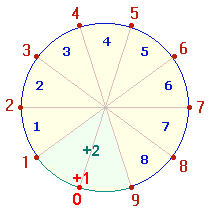
The final result 515, in which Shakespeare finds his NS 103 five times, has a highly symbolic meaning. If the 5 diametric elements are numbered from 1-5, the second half of the circle starts with 5:
|
|
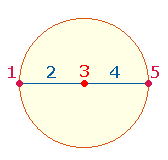
If Jesus Christ as the Son of God takes the
place of number 5, he has chosen MARIA to complete the second semicircle by her giving
consent to his incarnation.
The 4v-sum 252 exactly shows that the 5 elements of the circle axis create two areas and two
arcs. The palindrome 252 contains
the palindromic factors 12*21 whose
single digits can serve to represent the revolving character of the circle:
|
|
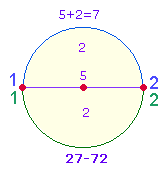
In addition, the 4v-sum 252 is here composed in such a way that the NS+FV1 and FS+FV2 form a
numeric ratio:
|
NS |
FV1 |
sm |
FS |
FV2 |
sm |
tot. |
|
108 |
24 |
132 |
73 |
47 |
120 |
252 |
|
132:120 = 12*( |
||||||
3.
The
fourth step consists of the two contractions of the four Y-words:
|
|
NS |
FS |
sm |
FV1 |
FV2 |
sm |
tot. |
|
YT |
42 |
42 |
84 |
12 |
12 |
24 |
108 |
|
MYE |
40 |
35 |
75 |
11 |
12 |
23 |
98 |
|
sm |
82 |
77 |
159 |
23 |
24 |
47 |
206 |
|
84:75 = 3*(28:25) = 3*53 |
|||||||
|
206 = 2*103 |
|||||||
Astonishingly, the 4v-sum of the two words is again divisible by 103. 5+2 may
characterise, as shown in the graphic, the elements of one semicircle. The
(countable) digits of number 103 itself can be referred to a circle line divided by two
points:
|
|
|
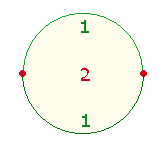
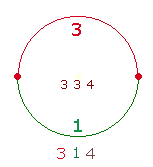
As the right graphic shows, the divided circle
line can represent the trinitarian principle, the first three digits of p, and a pattern of the number 10.
In addition, 206 can be understood as 20+6 which is the number of elements of the octahedron:
Jesus Christ unites in himself two natures represented above by the ratio 2*(
4.
If the
two results are added, the right and left halves are divisible by 7:
|
|
NS |
FS |
sm |
FV1 |
FV2 |
sm |
tot. |
|
YIOS THEOU |
129 |
84 |
213 |
29 |
21 |
50 |
263 |
|
YT |
42 |
42 |
84 |
12 |
12 |
24 |
108 |
|
sm |
171 |
126 |
297 |
41 |
33 |
74 |
371 |
|
MARIAE YIOS |
108 |
73 |
181 |
24 |
47 |
71 |
252 |
|
MYE |
40 |
35 |
75 |
11 |
12 |
23 |
98 |
|
sm |
148 |
108 |
256 |
35 |
59 |
94 |
350 |
|
total |
319 |
234 |
553 |
76 |
92 |
168 |
721 |
|
371:350 = 7*(53:50); 126:108 = 18*(7:6) |
|||||||
|
553:168 = 7*(79:24) |
|||||||
The FV1/2-sums 74 and 94 are the
NS of WILLIAM and OVIDIUS. The
sums 41 and 33 correspond to ILLIA and WM. SHAKESPEARE's NS 103 is contained
seven times in 721.
5.
Step 3
adds the 4 Y-words as the basis of the above circular
arrangement:
|
YE |
28 |
28 |
56 |
11 |
11 |
22 |
78 |
|
YT |
42 |
42 |
84 |
12 |
12 |
24 |
108 |
|
YT |
42 |
42 |
84 |
12 |
12 |
24 |
108 |
|
MY |
35 |
30 |
65 |
12 |
10 |
22 |
87 |
|
sm |
147 |
142 |
289 |
47 |
45 |
92 |
381 |
The inverted sums 78 and 87 anticipate their converging role in
closing two semicircles. The sums of the three steps 721+381 = 1102 = 2*19*29 curiously are identical with the 4v-sum of Ovid's and Shakespeare's names.
6.
Now
the 4v-sum of the four Greek words (step 2) has to be added to the two previous ones:
|
319 |
234 |
553 |
76 |
92 |
168 |
721 |
|
147 |
142 |
289 |
47 |
45 |
92 |
381 |
|
327 |
200 |
527 |
56 |
44 |
100 |
627 |
|
793 |
576 |
1369 |
179 |
181 |
360 |
1729 |
|
1369 = 37*37; 576:360 = 72*(5:8) |
||||||
|
793:936 = 13*(61:72) = 7*(13*19) |
||||||
The letters
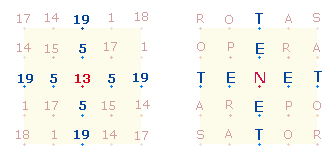
equivalent to 13 and 19 are NT constitutive of the TENET cross of the SATOR Square. 61 is the NS of TENET.
7.
Although
the Y-words have been included already, they
should, as the first step, once more added:
|
793 |
576 |
1369 |
179 |
181 |
360 |
1729 |
|
147 |
142 |
289 |
47 |
45 |
92 |
381 |
|
940 |
718 |
1658 |
226 |
226 |
452 |
2110 |
|
940+226 = 1166 = 11*106 |
||||||
In looking
at the results, we should not forget Shakespeare as the author of the gematric
construction. Did he know or aim at these exact results? We should assume so if
they reveal sense and meaning.
Two sums, 226 and 106, refer to gematric
values of IESUS CHRISTUS: 226 is the 4v-sum of CHRISTUS and 106 the NS+FS of IESUS. Twice the sum 226 is striking, it may
again refer to the two natures of the Son of God. In addition, 452 is the NS+FS of the four axes
(vertical-horizontal, diagonal) of the SATOR Square. 113 is the numbered sum of
the four axes:
|
|
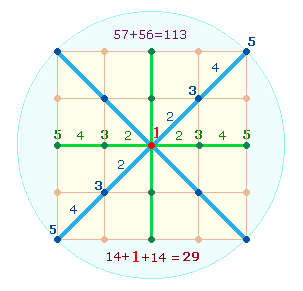
The number 211 is prime, it's the
inversion of 112, the NS of CHRISTUS. It can mean his new existence
after his resurrection.
1.
The
four Greek Y-words are taken from the message of the
Angel Gabriel. The word YIOS, however,
occurs a third time in the accusative form YION when the Angel announces to Mary that she
would conceive a son whom she should give the name IESOUN. Before the Angel gives this message he
addresses the virgin: Don't be afraid, MARIAM. The Greek text uses the original
Shakespeare treated the four Y-words freely. He found that the single Greek letter Theta is written with two letters in Latin, so in return he
neglected the initial pronounciation of H in (H)YIOS. On the other hand he kept to Greek OU in THEOU although
the two letters are pronounced as one sound.
If Shakespeare looked at the gematric
values of the additional three words, he may have decided to neglect the final
letter M in MARIAM. The gematric values he then established
must have excited him in the highest degree:
|
|
NS |
FS |
sm |
FV1 |
FV2 |
sm |
tot. |
|
MARIA |
40 |
32 |
72 |
11 |
10 |
21 |
93 |
|
YION |
58 |
41 |
99 |
31 |
41 |
72 |
171 |
|
IESOUN |
79 |
50 |
129 |
79 |
12 |
91 |
220 |
|
sm |
177 |
123 |
300 |
121 |
63 |
184 |
484 |
|
121:(177+123+63) = 121:363 = 121*(1:3) |
|||||||
|
220:(93+171) = 220:264 =
44*(5:6) |
|||||||
Shakespeare found that the NS and FS of the three
words are the exactly the same as for his own two names:
|
|
NS |
FS |
sm |
FV1 |
FV2 |
sm |
tot. |
|
WILLIAM |
74 |
52 |
126 |
39 |
17 |
56 |
182 |
|
SHAKESPEARE |
103 |
71 |
174 |
103 |
71 |
174 |
348 |
|
sm |
177 |
123 |
300 |
142 |
88 |
230 |
530 |
To discover this surprising
concordance may have given Shakespeare strong motivation for his epitaph. For
example, the NS of its fourth line is 313, just like the 4v-sum 93+220 of MARIA and IESOUN.
2.
Shakespeare
realised the relevance of the two results of 4+3 words at once:
|
4 w. |
21 le. |
327 |
200 |
527 |
56 |
44 |
100 |
627 |
|
3 w. |
15 le. |
177 |
123 |
300 |
121 |
63 |
184 |
484 |
|
|
36 le. |
504 |
323 |
827 |
177 |
107 |
284 |
1111 |
|
627:484 = 11*(57:44) = 11*101
>
FV 112 |
||||||||
The numbers 11 and 101 obviously
refer to the Second Divine Person. The FV 112 is the NS of CHRISTUS.
The factors of 504 are 9*8*7 as the
symmetrical counterparts of the first three numbers 123. The average NV of the 36 letters is 14, just like that of the names IESUS (70) CHRISTUS (112).
The NS+FS 827 has trinitarian
meaning in that it can be understood as 8+27 which is 2³+3³.
3.
For
Shakespeare and Christian believers it is clear that the gematric order of the
seven words examined has neither come about by chance nor by the evangelist
Luke, but by the Divine Spirit who permeates the creation with the wisest order
that exists independent of what the human spirit has recognized or will
recognize. The gematric concept is his work as well. It's part of what is said
about the holy scriptures' divine inspiration. While
Roman authors like Ovid encoded order into their texts, this is done in the
gospels by the Holy Spirit.
What Shakespeare did, was to
discover gematric connections with regard to the annunciation of the Angel
Gabriel to the Virgin Mary. There are innumerable other comparable connections
but unexplored and unexplorable by the human mind.
4.
If we
look at the initials of the seven words, there is a problem of the H. As there
is no single letter for the Greek letter Theta (J) in THEOU, we should count two letters. In consequence we
should then count two letters for HYIOS
and HYPSISTOU,too:
|
|
HY |
TH |
HY |
HY |
M |
HY |
I |
sm |
|
NS/V |
30 |
27 |
30 |
30 |
12 |
30 |
9 |
168 |
|
FS/V |
19 |
25 |
19 |
19 |
7 |
19 |
6 |
114 |
|
|
199 |
83 |
282 |
|||||
|
114:168 = 6*( |
||||||||
The number of initials has
increased from 7 to 12 letters. The average NV of each letter is 14 like with the 36 letters of the seven words.
The ratio
|
|
5.
The
sound H is especially associated with the Holy Spirit: After his resurrection, when Jesus
appeared to his disciples, he "breathed on them" and said:
"Receive the Holy Spirit" (John 20,22). The 5 H have the NS 40 of MARIA, if the FS 30 is added, the NS+FS 70 is the NS of IESUS. It is a demonstration of how the 4 points and 3 lines of one
tetractys side can be understood: as ratio of part to whole 4:(4+3). Jesus
is both the divine creator of the Virgin Mary and takes his human nature from
her through the Holy Spirit. 30+40 may characterise the two natures of IESUS.
Written/March 2009
Revised: June 2014