SHAKESPEARE AND OVID
Gematric concordance of two tombstone
inscriptions
A.
Values of Text and Names
B. The SATOR
Square as Reference Model
I. Introduction II. Reference in Shakespeare's Epitaph
III. Reference to IESUS CHRISTUS
a) Introduction b) Reference in OVID's Epitaph
c) Reference in Shakespeare's Epitaph
A. Values of Text and
Names
|
Hic ego qui iaceo
tenerorum lusor amorum |
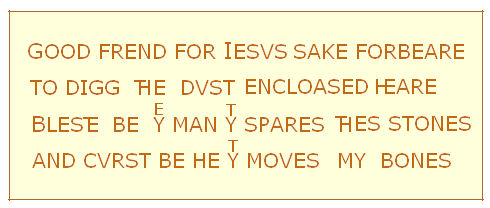
GOOD FREND FOR IESVS SAKE FORBEARE |
|
ingenio perii Naso
poeta meo; |
TO DIGG
THE DVST ENCLOASED HEARE. |
|
at tibi qui transis
ne sit grave quisquis amasti |
BLESTE BE YE MAN YT SPARES THES STONES |
|
dicere
"Nasonis molliter ossa cubent". |
AND
CVRST BE HE YT MOVES MY BONES. |
|
Here I lie, playful composer
of tender love stories, |
|
|
Naso the poet,
ruined by my own genius; |
|
|
But for you, who
pass by and have ever loved, may it |
|
|
not be hard to say " Naso's bones may softly rest. |
|
Some
useful literary background knowledge and stylistic details about Shakespeare's
epitaph have been elaborated by Alfred Corn.
NOTE on YE and YT: There was a
medieval letter "thorn" (þ) for today's
"th" which in handwriting became indistinguishable from y. When books were printed, the article THE was often written
Y with a superscript E and THAT with a
superscript T:
|
|
|
E |
|
T |
|
BLESTE |
BE |
Y |
MAN |
Y |
|
Blessed |
be |
the |
man |
that |
1.
Shakespeare highly appreciated the Roman poet Publius
Ovidius Naso. After discovering Shakespeare's fantastic knowledge of Latin gematria
and its principles in Sonnet 136, I guessed Shakespeare might have
taken Ovid's tombstone inscription of equally four lines as a model to define
the numeric values of his own. He undoubtedly did so. Numbers are undeniable
facts. The numbers established must be proved to exclude coincidence.
I first give Ovid's,
then Shakespeare's epitaph on the basis of 23 or 24 letters respectively.
I add two tables of the Latin and Elizabethan alphabets together with
an online
calculator.
In Shakespeare's time the letters I/J and U/V were used
alternatively regardless of their phonetic quality; the letter W – which does not occur
in Shakespeare's epitaph – takes the 21st position. Beside the
numeric values (NV), the factoral values (FV) – either identical with prime numbers or additions of single prime
factors (e.g. 9 = 3*3 = FV 3+3 = 6) – are important:
1. hic (20) ego (26) qui (45) iaceo (32) tenerorum
(122) lusor (80) amorum (76)
7 (7) 34 (34) 401 (401)
2. ingenio (70) perii (55) Naso (46) poeta (54) meo; (31)
5 (12) 24 (58) 256 (657)
3. at (20) tibi (39) qui (45) transis (95) ne (18) sit (46) grave (50)
quisquis (126) amasti (60)
9 (21) 40 (98) 499 (1156)
4. dicere (43) "Nasonis (86) molliter (98) ossa (51) cubent". (62)
5 (26) 31 (129) 340 (1496)
1496 = 2* 2* 2* 11* 17 = 44*34 = FV 34
1. GOOD (39) FREND (45) FOR (37) IESVS (70) SAKE (34) FORBEARE (67)
6 (6) 29 (29) 292
(292)
2. TO (33) DIGG (27) THE (32) DUST (61) ENCLOASED (74) HEARE (36)
6 (12) 27 (56) 263
(555)
3. BLESTE (60) BE (7) YE (28) MAN (26) YT (42) SPARES (74) THES (50) STONES (87)
8 (20) 31 (87) 374
(929)
4.
AND (18) CURST (77) BE (7) HE (13) YT (42) MOVES (69) MY (35) BONES (52)
8 (28) 26 (113) 313
(1242)
1242= 2* 3* 3* 3* 23 = 18*69 = FV 34
More about the number 34.
The
FV
are listed in the order of words and lines:
|
OVID |
|
SHAKESPEARE |
|
total |
|
15+21+23+24+101+54+50 |
288 |
29+44+31+36+21+61 |
222 |
510 |
|
59+42+31+42+21 |
195 |
28+24+30+40+59+34 |
215 |
410 |
|
20+33+23+72+18+33+39+62+42 |
342 |
50+7+28+21+42+47+38+62 |
295 |
637 |
|
40+58+85+26+51 |
260 |
18+56+7+11+42+38+30+37 |
239 |
499 |
|
|
1085 |
|
971 |
2056 |
2. The
factoral value (FV) of the two numerical results 1496 and 1242
is 34 each.
The
gematric values and numbers of letters of both epitaphs consist of the
following prime factors:
|
gemat.values |
1496+1242 = 2738 |
2*37*37 |
|
letters |
129+113 = 242 |
2*11*11 |
Shakespeare
in both cases chose a square number below Ovid's results and counted the
difference back to his own values: The interval from 1369 (=37*37) to 1496 is 127 (1369-127 = 1242) and from 121 to 129
it is 8. In this
way Shakespeare can share a square number with Ovid. The factoral value of 37*37 is 74,
which is the numerical sum (NS)
of WILLIAM.
More
details about the NS and FS of both inscriptions are dealt with in ADDENDUM 1.
3. The NS
and FS + their corresponding FV – which together I call 4values – of both poets' names
are:
|
|
NS |
FS |
sm |
FV1 |
FV2 |
sm |
tot. |
|
PUBLIUS |
95 |
53 |
148 |
24 |
53 |
77 |
225 |
|
OVIDIUS |
94 |
51 |
145 |
49 |
20 |
69 |
214 |
|
NASO |
46 |
31 |
77 |
25 |
31 |
56 |
133 |
|
sm |
235 |
135 |
370 |
98 |
104 |
202 |
572 |
|
145
= 5*29; 572 = 4*11*13 |
|||||||
|
WILLIAM |
74 |
52 |
126 |
39 |
17 |
56 |
182 |
|
SHAKESPEARE |
103 |
71 |
174 |
103 |
71 |
174 |
348 |
|
sm |
177 |
123 |
300 |
142 |
88 |
230 |
530 |
|
tot. |
412 |
258 |
670 |
240 |
192 |
432 |
1102 |
|
145:174 = 29*(5:6); 572+530 =
1102 =
2*19*29 |
|||||||
|
412 =
4*103; 240:192
= 48*(5:4) |
|||||||
The NS+FS of OVIDIUS and SHAKESPEARE have the factor 29 in common, forming the ratio 29*(5:6). The factor 29 is also contained in
the total sum 1102.
The NS of the five names
contains the NS 103 of SHAKESPEARE four times.
The NS+FS 300 is also the sum of the letters 1-24 of the Elizabethan
alphabet. The only new letter is W, which is the initial of WILLIAM.
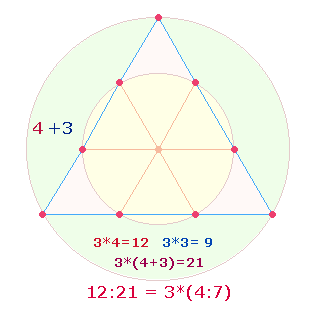
The geometric reference model for 103 is the hexagram with 1+6+3 = 10 points of one
tetractys and remaining 3 points for the second:
|
|
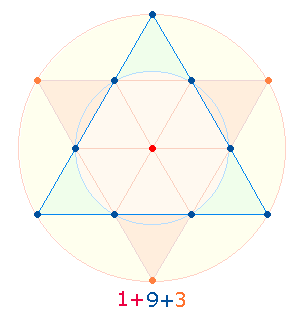
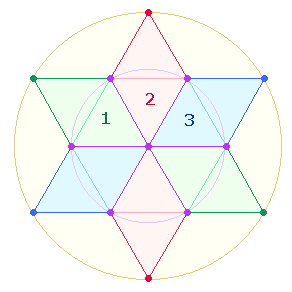
As one tetractys consists of 37 points, the NS 74 of WILLIAM
stands for two tetractyses and again for the whole hexagram. Furthermore, the NS+FS 126 of WILLIAM
associates him with 2*3 double rhombi each
consisting of 21 elements. Shakespeare obviously had a precise
knowledge of the relationship between basic geometrical figures and the decimal
system.
4.
The following table shows the importance of the two
numbers 47 and 37:
|
|
|
NS |
FS |
|
|
PUBL|IUS |
48+47 |
95 |
53 |
148 |
|
OVID|IUS |
47+47 |
94 |
51 |
145 |
|
NASO |
|
46 |
31 |
77 |
|
|
|
235 |
135 |
370 |
The NS 94 of OVIDIUS is twice 47 and increases by
another 3*47, if the values of the other two names are added up. Thus
the ratio of 1:2 names is 2:3 with regard to their numeric values.
Another relation of 1:2 names occurs, if NS+FS are added up: PUBLIUS amounts to 148 = 4*37, OVIDIUS
NASO to 222 = 6*37 = 74*(2:3).
The
number 37
is contained twice in the NS 74 of WILLIAM. The two words ENCLOASED and SPARES have
the same NS 74, BONES the
same FS 52 as WILLIAM and
are therefore of special
interest.
Another concordance exists in 18 letters both of Ovid's and Shakespeare's names.
5.
Ovid mentions his name twice in his
epitaph, NASO and NASONIS, so we can suppose a gematric plan:
|
|
NS |
FS |
sm |
FV1 |
FV2 |
sm |
tot. |
|
NASO |
46 |
31 |
77 |
25 |
31 |
56 |
133 |
|
NASONIS |
86 |
58 |
144 |
45 |
31 |
76 |
220 |
|
|
132 |
89 |
221 |
70 |
62 |
132 |
353 |
The NS of NASO and NASONIS are 46+86 = 132 = 12*11 so that the average value a letter is 12. The NS+FS of the two names are 77+144 = 221 = 13*17: The factors 11 and 17 are part of the total NS of the epitaph: 8*11*17.
By contrast, Shakespeare does not
mention his name. For example, there is no letter W in the text.
B. The SATOR Square as Reference Model
I. Introduction
1.
Analyzing Sonnet 136, I discovered that Shakespeare
not only employed gematria, but also knew about the significance of the SATOR square, the
outstanding pre-Christian document of Roman numerology. I wonder how he
obtained all the complex knowledge of the Roman system, but he was obviously
able to apply it perfectly.
2.
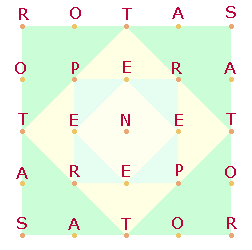
The SATOR square if read properly forward
and backward allows to form two sentences:
SATOR OPERA TENET – The Creator holds his works.
TENET OPERA ROTAS – He holds the wheels with care.
The
following graphic represents the original view of the square with ROTAS in the first line:
|
|
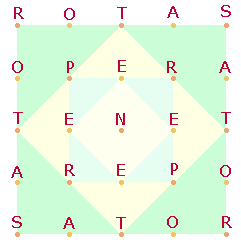
The word
ROTAS is also
a verbal form, meaning You turn (the
wheels).
II. Gematric Reference in
Shakespeare's Epitaph
1.
Shakespeare's epitaph contains three words with the same
numeric values as the SATOR square:
|
S. Sq. |
Epitaph |
NS |
|
SATOR |
MOVES |
69 |
|
OPERA |
BONES |
52 |
|
TENET |
DUST |
61 |
|
69+113 |
182 |
|
The
words BONES and DUST have synonymic meaning, so they form a semantic
unit against MOVES. The NS 113
of the two synonyms is also the number of letters of the inscription. The NS 69 = 3*23 is contained 18 times in the epitaph's
total NS 1242.
2.
Why did Shakespeare insert three
words with the NS of the
SATOR square words? One reason
is that the 4values of WILLIAM amount to 182.
|
|
NS |
FS |
sm |
FV1 |
FV2 |
sm |
tot. |
|
WILLIAM |
74 |
52 |
126 |
39 |
17 |
56 |
182 |
The second reason is that the NS of IESUS CHRISTUS
is also 182:
|
IESUS |
70 |
36 |
106 |
|
CHRISTUS |
112 |
76 |
188 |
|
|
182 |
112 |
294 |
The NS+FS ratio
of WILLIAM and IESUS CHRISTUS is 126:294 = 42*(3:7).
The third reason is that in this way Shakespeare could unite
two comparable models of Antiquity and Christianity.
Sc. More
about the three groups: the 4values
3.
The three words consist of 14 letters. The NS 182 is divisible by 14, so each letter has
the average NV
13.
4.
The three words of the epitaph draw their meaning from the
correponding words of the SATOR square: No human being is entitled to
disturb the poet's earthly rest, because it's God (SATOR) who has held and
guided (MOVES) Shakespeare throughout his life (18*69) and also takes care of him (OPERA
TENET)
after his body has decayed (BONES, DUST). He turns (ROTAS, MOVES) his mortality into
immortality.
DVST shares its NS 61 and FS 40 with CRVX – Cross: After his death on
the Cross Jesus Christ rose from death again, and all who believe in him will
follow. The word DVST stands for what is materially left of a person. But
Christ's redemptive deed gives hope that there is life after death and body and
soul will be transfigured on the Day of the Last Judgement.
5.
In Shakespeare's view there are personal SECRETS which he shares only
with his Creator and which to investigate by opening his tomb is tantamount to
sacrilege.
III. Reference to IESUS CHRISTUS
1.
Latin gematria may have been revived during Renaissance.
Those who concerned themselves with it, must have been struck by the ideal NS of IESUS (70) CHRISTUS
(112): The
average NV of both names is 14. As
the SATOR square was generally known during the Middle Ages and also
represented in a number of churches, it was easy to discover that the NS of IESUS
CHRISTUS and SATOR OPERA TENET is equal. It suggested the theological view that God's
providence chose the Romans to develop the ideal language for the Christian
faith, and, connected with it, an ideal gematric system.
2. Shakespeare must have
known that IESUS (70) CHRISTUS (112) – 13 letters – has the same
NS
182 as SATOR
OPERA TENET–
15 letters. He inverted the 13 letters and average NV 14 of IESUS
CHRISTUS by choosing 14 letters and an average NV of
13. In this he assumed a
kind of mediatory role as he brought about the average NV 13 for
15+14+13 = 42
letters.
3.
As the first line of the epitaph mentions the name of IESUS explicitly, the three
words and their values have to be referred to it. Here the factoral values (FV) are also important:
|
|
MOVES |
BONES |
DUST |
sm |
IESUS |
tot. |
|
NS |
69 |
52 |
61 |
182 |
70 |
252 |
|
FS |
38 |
37 |
40 |
115 |
36 |
151 |
|
|
403 |
|||||
|
403 = 13*31 |
||||||
The two
results 252 and 151 have the same first and
last numbers and so imply a state of inversion. 252 can be represented by the inverted product numbers
12*21 and 115
is changed into 151,
and the total sum 403 consists
of the inverted prime factors 13*31,
bearing obvious trinitarian meaning. So Shakespeare indicates that it's Jesus
who transforms what is mortal in him into immortality.
IV. Reference to PENSATOR
a)
Introduction
1.
The SATOR Square contains 8 different letters
which can be arranged to form the word PENSATOR. It refers to the act
of weighing. Theologically it means that God rewards human beings
after their earthly lives according to their merits.
The two
halves of letters have each the same NS 51,
thus symbolizing a pair of scales:
|
P |
E |
N |
S |
A |
T |
O |
R |
|
20 |
31 |
20 |
31 |
||||
|
51 |
51 |
||||||
2.
Because of its importance Roman poets often construct
meaningful gematrical results out of these 8 letters of PENSATOR. The NS+FS is 102+80 = 182 and so identical with
the NS 182 of SATOR OPERA TENET and IESUS
CHRISTUS. The corresponding FV 22+13 are reflected in
the NS+FS 2213 of Shakespeare's
epitaph.
b)
Reference in OVID's Epitaph
1.
The 8 letters lead to the following numeric results according
to their frequency in Ovid's epitaph:
|
|
P |
E |
N |
S |
A |
T |
O |
R |
|
|
NV |
15 |
5 |
13 |
18 |
1 |
19 |
14 |
17 |
102 |
|
frequ. |
2 |
14 |
9 |
12 |
11 |
9 |
12 |
9 |
78 |
|
total |
30 |
70 |
117 |
216 |
11 |
171 |
168 |
153 |
936 |
|
936
= 72*13 =
8*117 |
|||||||||
|
30+168+30 = 351 = 27*13; 70+216 = 286 = 22*13 |
|||||||||
|
117 =
9*13; 11+171 = 182 = 14*13 |
|||||||||
Four
combinations of NS can be found which are
divisible by 13.
Two times two of them can be arranged as to make up 468 each, half
the total sum of 936. The
four groups consist of 2+2+3+1 letters.
|
|
A |
T |
E |
S |
P |
R |
O |
N |
|
NV |
43 |
59 |
||||||
|
NS |
182 |
286 |
351 |
117 |
||||
|
/13 |
14 |
22 |
27 |
9 |
||||
|
total |
36 |
36 |
||||||
2.
The 8 letters can be read either as 2 words or 4 words. The words ATES PRON do not form a
syntactic unity, their sense has to be guessed. The Greek word ATE means guilt caused by blindness
of mind and soul and, in consequence, by irrational passions. ATE is also a mythological
personification and a daughter of Zeus who, after being hurled down to earth by
her father, wreaks havoc on mortals. ATES is
the possessive case meaning in the possession of ATE. Ovid wants to say he fell prey to ATE, doing things that
charge him with guilt.
The Latin word PRON- lacks its grammatical
ending –US. It means in downward position, heading downward. It may refer to
everything that disgraces man's true nature and dignity. So Fate may precipitate the sinner into the
depths of TARTARUS.
3.
Consistent with this self-incrimination is the first
distichon and the word PERII – I perished. Then, however, the
first word of the second distichon is AT – But, indicating that there
is a chance for pardon and salvation.
From the pre-arranged order of
letters we can now argue backward: The 8 letters ATESPRON only seem to consist
of two words, in reality there are four groups of letters divisible by 13, which number represents
the unity of God in three divine persons. These four words AT ES PRO
N reflect
Ovid's confidence that, in return for his poetic efforts and his religious
devotion, he may expect mercy and eternal happiness. So the Latin meaning is:
BUT YOU ARE FOR N.
PRO N
can be complemented with PRO
N-ASONE
– in favour of NASO. The
additional 5 letters
have the NV 51 so that
the NS of the whole phrase is 3*51 = 153.
4.
Of the four words the letters AT are the only adjacent ones in PENSATOR. Their NS
182 is identical with the NS of SATOR OPERA TENET.
The two letters also mark the beginning of the second half of PENS|ATOR and the backward reading of
c)
Reference in Shakespeare's Epitaph
1.
If we presuppose that Shakespeare knew about the practice
of referring a poem or text unit to the name PENSATOR, he might not have
done so himself only with regard to the
|
|
P |
E |
N |
S |
A |
T |
O |
R |
|
|
NV |
15 |
5 |
13 |
18 |
1 |
19 |
14 |
17 |
102 |
|
frequ. |
1 |
21 |
6 |
14 |
7 |
9 |
9 |
7 |
74 |
|
total |
15 |
105 |
78 |
252 |
7 |
171 |
126 |
119 |
873 |
|
|
I |
E |
S |
U |
C |
H |
R |
T |
|
|
NV |
9 |
5 |
18 |
20 |
3 |
8 |
17 |
19 |
99 |
|
frequ. |
2 |
21 |
14 |
4 |
2 |
4 |
7 |
9 |
63 |
|
total |
18 |
105 |
252 |
80 |
6 |
32 |
119 |
171 |
783 |
|
252 =
12*21; 171 = 9*19; 252+171 = 423 = 9*47 |
|||||||||
The two results 873 and 783 are again inversions.
Their ratio is 9*(97:87) = 9*184 = 9*8*23 = 1656. So it's again Jesus
Christ who turns the mortal fate of man into eternal fulfilment. As a matter of
fact, the two inverted results form a unique ratio with Ovid's PENSATOR result 936: 72*(
There are similar
results for the letters ST in
Ovid's and Shakespeare's epitaphs:
|
Ovid |
Shakespeare |
||||
|
S |
T |
|
S |
T |
|
|
216 |
171 |
387 |
252 |
171 |
423 |
|
387 =
9*43; 423 = 9*47 |
|||||
The NV of ST refer
to the 18+19 = 37 elements of the tetractys: 18
lines, 10 points + 9 triangles and to
the 4 points and 3 lines of one
side of the tetractys. 9*43 can be read as 3*4
points + 9 lines:
|
|
The
4 Y-words (revised
2014)
Addendum1: 4values of text and
lines
Addendum2:
4values of words
Addendum3:
unity of 3*4values of Ovid's epitaph
How Shakespeare understands his first name WILLIAM
Analysis
of structure and contents of both epitaphs
First,
central, last word of the epitaphs
The
7 different letters of SHAKESPEARE
4+1
alliterations in Shakespeare's epitaph
The
factoral sum 791 of Shakespeare's epitaph
The 26 and 28 initials in Ovid's and Shakespeare's epitaphs
Ovid's
and Shakespeare's names in Tetractys and Double Rhombus
Three Augustan poets + Shakespeare
Written: December 2008
Last entry: June 2014