gematric
calculator
The Saviour's Smile in Eclogue 4
RISU
in the Names of MARIA and IESUS
|
|
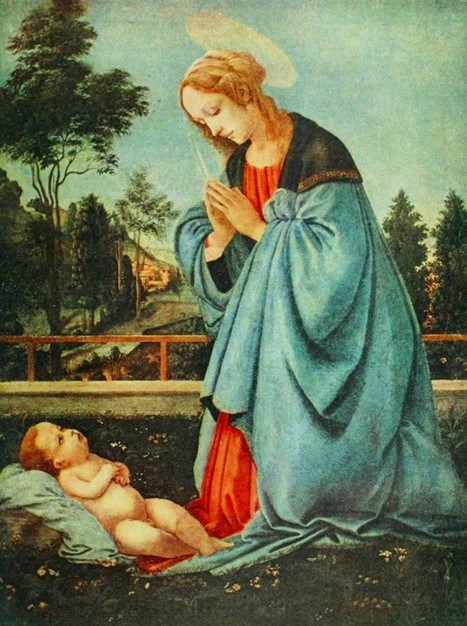
I. Aspects of the Decimal
System in the names of MARIA and IESUS
II. Vergil's
Eclogue 4, 60-63: Gematric aspects
III. The last
sentence (62-63)
I. Aspects of the Decimal System in the names of MARIA and IESUS
1.
The numerical values (NV) of MARIA and IESUS are 40+70 = 110 = 2*55. The sum of the numbers 1-10 is 55. While the 10 numbers can be placed on the points of one tetraktys, the twice 5 letters of MARIA
and IESUS will have to be properly arranged on two
tetraktyses.
An alternating pattern of the two names
splits the numerical sum (NS) 110 into
two halves:
|
|
M |
A |
R |
I |
A |
I |
E |
S |
U |
S |
sm |
|
NS1 |
12 |
|
17 |
|
1 |
|
5 |
|
20 |
|
55 |
|
NS2 |
|
1 |
|
9 |
|
9 |
|
18 |
|
18 |
55 |
|
|
|
|
|
|
|
|
|
|
|
|
110 |
The count of values starts
from the first letter of MARIA and
proceeds in two groups of uneven and even numbers from 1-10.
This alternating pattern of
uneven and even numbers with the same gematric results reveals the closest
possible interrelation between MARIA and IESUS. It shows that MARIA puts her life totally in the service of her son and
his work of salvation. It even seems that her share in the work of salvation is
equal to her son's.
2. The letters of MARIA and IESUS have proved to be intertwined in their regular
juxtaposition. So it is most plausible to place the 5 letters of each name on the points of two tetraktyses
as regularly as possible. The start for each name will be the cornerpoints of
the two opposite tetraktyses, Mary's tetraktys running from top to bottom,
Jesus' from bottom to top. The second to fifth letters occupy the 4 horizontal points of each tetraktys:
|
|
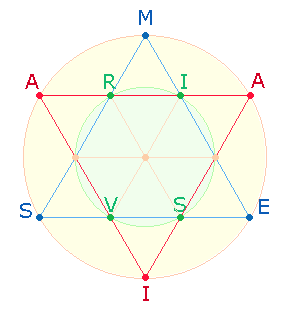
Each tetraktys is now composed of 4 hexagonal and 3 extension letters. There is a relation of 4 inner to 6 outer
letters (lts), whose numerical sum + factoral sum (FS)
are:
|
|
4 lts |
6 lts |
sm |
|
NS |
FS |
sm |
|
NS |
64 |
46 |
110 |
MARIA |
40 |
32 |
72 |
|
FS |
40 |
28 |
68 |
IESUS |
70 |
36 |
106 |
|
sm |
104 |
74 |
178 |
|
110 |
68 |
178 |
64 and 46 are inverted numbers, the digits showing accordance
with the 4+6 letters. There are two ratios: 40:64 = 8*(5:8); 40:28 = 4*(10:7). The ratio 10:7 corresponds to the 10 points of the tetraktys and 7 points of the hexagon.
3. The 4 hexagonal letters belong to both tetraktyses, so
their values have to be counted twice: 46+64+64 = 174; 68+40+40 = 108. The two sums are to each other as 6*(
These are the values of the two
tetraktyses:
|
|
Tetr. MARIA |
Tetr. IESUS |
||||
|
|
NS |
FS |
sm |
NS |
FS |
sm |
|
|
35 |
20 |
55 |
11 |
8 |
19 |
|
RISU |
64 |
40 |
104 |
64 |
40 |
104 |
|
|
99 |
60 |
159 |
75 |
48 |
123 |
|
|
159:123 = 3*(53:41) |
|||||
The ratio of the two FS 60:48 is 12*(5:4) = 12*9 , again confirming the initials of MARIA and IESUS.
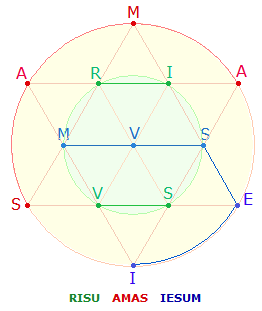
4. The four hexagonal letters,
read clockwise, show a Latin noun form in the ablative case, derived from RISUS – laughter, smile.
Two letters are taken from MARIA, two from IESUS. So the act of recognition and smile is a
mutual one.
If one follows the outer
points anticlockwise, starting from the A on the right, one can read AMAS – You love. One may suppose a speaker inwardly
addressing the Virgin Mary, as he observes her smiling at her child. The
remaining letters IE may be complemented like this:
RISU AMAS IE(SUM) – You show your love for Jesus
by smiling at him.
The letters SUM, which
are contained in the two names, complete the 13 points of the tetraktys star, occupying the missing
points of the central axis:
|
|
5.
Love arises only between persons. It is engendered by acts of mutual
recognition. Human love is a divine gift, and its eternal model is the loving
relationship between the trinitarian persons of Father, Son, and Holy Spirit.
A SMILE starts from a person's mouth and expands
over his whole face. So love transgresses all boundaries. Such a boundary is the
hexagon that is expanded to form a hexagram including two tetraktyses. The
hexagram is completed by a circle whose area is three times the size of the hexagon area. This expansion can be
understood as self-manifestation of the trinitarian persons whose origin is the
First person or God Father: The hexagon represents the unity of the Father with
the Son and the Holy Spirit, the hexagram their loving relationship.
6.
The alternating pattern of uneven and even numbers in MARIA and IESUS resulted
twice in the NS 55, which is the sum of the numbers 1-10. This corresponds to 2*10 points of two tetraktyses. So mother and son embody
the perfect idea of the decimal system.
Besides, the tetraktys star contains three
double rhombi:
|
|
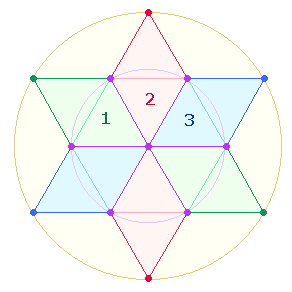
One double rhombus consists of 7 points, 4
triangular areas and 10 lines. These
elements exactly characterise the NS of MARIA IESUS in the structure of the ratio 10*(4:7) = 10*11. This structure can be shown in the three
tetraktys sides and on a straight distance:
|
|
|
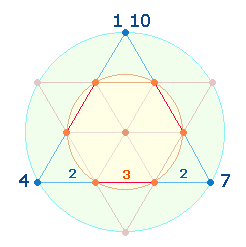
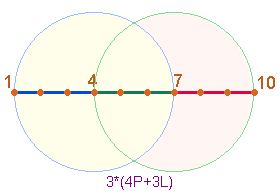
Here again we can see that 3*4 = 12 points and 3*3 = 9 units of measure correlate to the the initials of MARIA and IESUS. It
shows that Jesus was included in his mother's womb.
While the tetraktys emphasises the decimal
system by the number of 10 points, it's in the double rhombus the 10 units of measure. 7 points + 4
triangular areas combine to represent 11
delimiting points for 10 units of
measure:
|
|
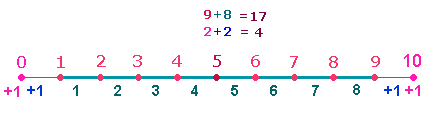
The figure shows the 9 different basic numbers delimiting 8 units of measure. So 2 units of measure have to be added, as represented in the cross lines
of the double rhombus. If 8 units of measure
and 9 points are read as 89, twice 89 is 178, the NS+FS of the MARIA and IESUS. Twice 89 also forms an axis cross numbered from 1-9 from the centre point:
|
|
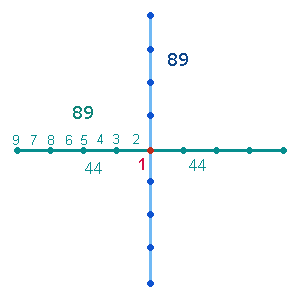
This axis cross can serve to support the
idea of Mary's role as coredemptrix – co-redeemer.
7. The two names can be placed
in various ways on the elements of the double rhombus of which I choose the
following:
|
|
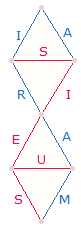
The letters are placed loop-shaped,
starting with MARIA below and continued by IES-, with the last two letters -US occupying the cross lines. The NS+FS of the lower and upper rhombi are:
|
|
NS |
FS |
|
|
NS |
FS |
|
|
5
lower |
56 |
30 |
86 |
4
lower |
36 |
21 |
57 |
|
5
upper |
54 |
38 |
92 |
4
upper |
36 |
30 |
66 |
|
|
110 |
38 |
178 |
|
72 |
51 |
123 |
56+54 are the constituents of their sum 110. 4 lower and 4 upper letters of the DR without the cross-line letters have the NS+FS 57+66, which are the FS+NS of the numbers 1-11, corresponding either to 11 elements of a single rhombus or to 7 points and 4 areas of
the double rhombus. The NS+FS of -US is 38+17 = 55.
8. The DR-zigzagline can be subdivided into 3 radial elements of the hexagonal part and 2 of the extension part. MARIA IESUS can be placed on these 10 radial elements from the central point:
|
|
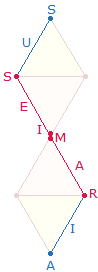
The NS+FS of
the four parts are:
|
hex. |
NS |
FS |
|
ext. |
NS |
FS |
|
|
MAR |
30 |
25 |
55 |
IA |
10 |
7 |
17 |
|
IES |
32 |
19 |
51 |
US |
38 |
17 |
55 |
|
|
62 |
44 |
106 |
|
48 |
24 |
72 |
The NS+FS 106 of the 6 letters of the hexagonal part is equal to the NS+FS of IESUS and the NS+FS 72 of the
extension part to the NS+FS of MARIA. There are also two cross relations: 55+55 = 110 and 51+17
= 68 for the NS and FS of the two names. The cross-combined letters can be
read als RAMUS | E(X) ISAI – a branch from Isai, the father of king David, referring to
the Book of Isaiah 11,1: "A shoot springs from the stock of Jesse",
predicting the Messiah, who would be born from a VIRGIN (Isaiah 7,14). The prophesy came true by the birth of
IESUS from the Virgin MARIA.
The ratio 24:48 = 24*(1:2) shows one important meaning of 72: Without the central point the hexagon
consists of 24 elements and the whole tetraktys star of 2*24 = 48 elements. So the ratio 1:2 elements means 1:3 area units
of the two concentric circles.
9. Similar to MARIA IESUS also CHRISTUS can be placed in loop form on the 8 lines of the frame of the double rhombus:
|
|
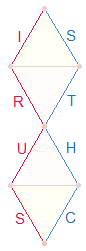
The letters of RISU are segregated on the four left lines. The NS+FS of the 4+4 letters are:
|
|
NS |
FS |
sm |
|
RISU |
64 |
40 |
104 |
|
CHST |
48 |
36 |
84 |
|
|
112 |
76 |
188 |
|
64:48 = 16*(4:3) |
|||
|
104:84 = 4*(26:21) = 4*47 |
|||
47 is the NS of DEUS – God, 26 the FS and 21 the difference between FS and NS. So the NS+FS of DEUS is 47+26 = 73, which is the NS of FILIUS – Son.
In this arrangement of letters CHRISTUS is recognised as the Saviour who looks at
each human individual with a loving smile.
A special characteristic of this
loop-shaped order is that the NS of the 4 hexagonal letters RU-TH (female figure
of the Old Testament) is the same as the NS of RISU: 37+27 = 64.
II. Vergil's Eclogue 4, 60-63: Gematric aspects
|
|
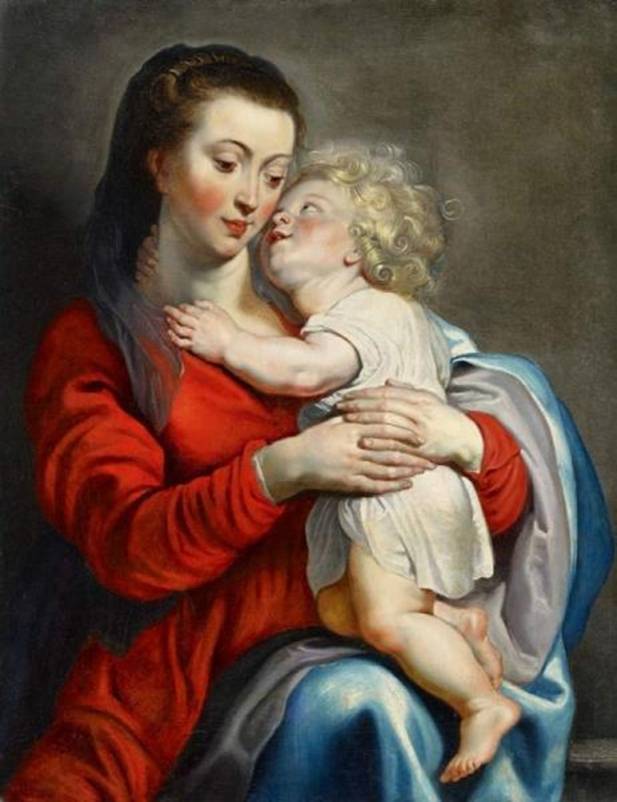
12 Years after investigating
into the last four lines of Vergil's eclogue 4 I've revised the original
version but I'm far from claiming to have found the solution, given the immense
complexity of gematric constructions. So my contribution should be regarded as
an approach to plausible answers. I add a study on Vergil's main gematric
principles.
1. In his famous 4th
eclogue the poet VIRGIL announces the birth of a boy who will
bring peace to the world. In line 60 he
says:
Incipe, parve
puer, RISU
cognoscere matrem
Begin, little
boy, to recognise your mother with a SMILE
Virgil invites the little boy to reward his
mother with a SMILE, while the tetraktys figure rather
suggests MARIA is taking the initiative. Virgil wants to say
that this child is so extraordinary that a smile is expected as a sign of his
divine origin. In reality, however, babies do not smile after their birth at
once. They are helpless bundles and have to be cared and caressed by their
mothers until their human faculties are gradually elicited.
2. It is from his overflowing
love that God created the world. So the two concentric circles of the tetraktys
star can be seen not only as an image of the trinitarian God himself, but also
of his creation. Out of love God's Son, his own image, became a human being,
and the loving smile between Mother and Son marks the beginning of hope for a
future era of reconciliation and peace.
3.
The word RISU is one
among 9 words which belong together. This last
text unit of Vergil's 4th eclogue consists of lines 60-63. The following text is provided with the NS+FS of each line. The values of single words can be
obtained by an online
calculator:
|
Incipe, PARVE PUER, RISU cognoscere MATREM: |
398 |
295 |
693 |
|
MATRI longa decem tulerunt fastidia
menses. |
395 |
313 |
708 |
|
Incipe, PARVE PUER: qui non RISERE PARENTI: |
404 |
305 |
709 |
|
|
1197 |
913 |
2110 |
|
nec deus hunc
mensa, dea nec dignata cubilI (E)ST. |
342 |
263 |
605 |
|
|
1539 |
1176 |
2715 |
|
1197:342
= 9*19*(7:2); 605 = 55*11; 2715 = 15*181 |
|||
Translation:
Begin, little
boy, to recognise your mother with a smile:
Ten months
caused your mother long inconveniences.
Begin, little boy:
Those who have not smiled at their parent (mother or father or both):
Neither a god
has considered him worthy of his table nor a goddes of her bed.
4.
I have not found any scholarly answer to the prolonged 10 months of pregnancy the little boy's mother
had to go through. From the point of view of the decimal system, the number ten
is the completion of the basic numbers 1-9. In analogy, the announced extraordinary boy crowns
and completes the history of mankind by his birth and the deeds of his life.
The tetraktys consists of
units of 10 and
5.
Having another look at the 9 words, we find that the repetition of PARVE PUER and the references to his mother MATREM MATRI PARENTI both consist of 18 letters, while RISU RISERE, serving as linking bond between Son and
Mother, amounts to 10 letters. So let's find out the values of
these 10 letters first:
|
|
RISU |
RISERE |
|
|
NS |
64 |
71 |
135 |
|
FS |
40 |
58 |
98 |
|
|
104 |
129 |
233 |
The values of the 4+3 words follow:
|
|
NS |
FS |
sm |
|
NS |
FS |
sm |
|
PARVE |
58 |
40 |
98 |
MATREM |
66 |
56 |
122 |
|
PUER |
57 |
39 |
96 |
MATRI |
58 |
50 |
108 |
|
sm |
115 |
79 |
194 |
PARENTI |
79 |
69 |
148 |
|
double |
230 |
158 |
388 |
sm |
203 |
175 |
378 |
|
230+203 = 433; 158+175 = 333 |
|||||||
Son and Mother correspond to
each other by the inverted NS 230 and 203. The digits of the sum 433, a prime number, show the structure of the 10 tetraktys points (4+3)+3. Also 433, a prime number,
is the area size of an equiliteral triangle (exactly: 0.433).
6.
The total results of the three groups (PRM) are:
|
P |
230 |
158 |
388 |
2M+P |
203 |
175 |
378 |
|
R |
135 |
98 |
233 |
621+378 =
999 |
|||
|
|
365 |
256 |
621 |
|
|||
|
621:378=27*(23:14) = 27*37 |
|||||||
|
365+203 = 568; 256+175 = 431 |
|||||||
|
175:203 = 7*(25:29) = 7*54 |
|||||||
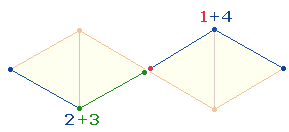
378 is the sum of the successive numbers from 1-27. The ratio numbers 23+14
= 37 on the one hand represent
37 elements of the tetraktys, their digital
sums on the other hand are two ways of representing twice 5 radial elements of the zigzag-line of the double
rhombus:
|
|
7.
The product 27*37 is essential for the understanding of the
four lines. The VESTA-cult based on the tetraktys star, was SECRET, open to those only who had been
initiated. The formula and password for them was ST! imposing strict silence towards all who were not
initiated to the cult. For VESTA can be
read as VETAS meaning "you forbid", reminding the initiated of what the
goddess expected from them. The formal logic behind this formula is that the
tetraktys consists of 18 lines and 10 points + 9
triangular areas. The formula can be submitted to the 4-value calculation which
means that FV can be obtained from NS and FS:
|
|
P+A |
L |
sm |
FV |
sm |
|
NS |
19 |
18 |
37 |
37 |
74 |
|
FV |
19 |
8 |
27 |
9 |
36 |
|
sm |
37 |
27 |
64 |
46 |
110 |
The result shows that the two
inverted sums 64+46 = 110 provides
twice the sums of the numbers 1-10 = 55 for the 10 points of two tetraktys. We can see the parallel to
the NS 110 of MARIA IESUS: 64 is RISU on 4 hexagonal
points and 46 for the letters on 6 extension points.
The word RISU itself can be divided up into RU = 17+20 = 37 and IS = 9+18 = 27. 9 and 18 are the result
of theological speculation: The first 3 numbers 1+2+3 add up to 6. If there
is belief in 3 divine persons, the calculation runs 6+3 = 9 and 6*3 = 18.
The NS+FS 37+26 = 63 of UR is also of
importance: 63 is achieved, if the elements of the 3
levels of the tetraktys are added up:
|
|
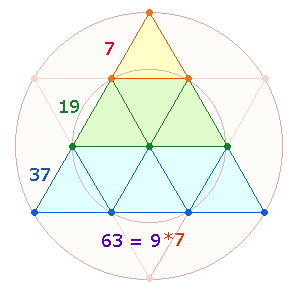
63 means 7 elements for each of the nine triangular areas.
Vergil may have considered 63 in the ZS+FS 693 = 11*63 of
line 60.
8.
If the 18 lines of the
tetraktys form one unit and the 10 points and 9 triangles the second unit of 37 elements, the FV of 18+19, meaning ST, are 8+19 = 27. So the product 27*37 = 999 represents the FS+NS of the two groups of elements.
The meaning of 27, as specifically relevant in the present
context, consists in the NV of P+M = 15+12 = 27, the initials of PUER and MATER. The FV of the two
numbers are 8+7 = 15. So it seems plausible to associate these
two numbers with the total NS+FS 2715 of lines 60-63. A plain, but plausible exlanation could
be that 2715 unites the initials of (PATER+MATER) + PUER.
9.
If 27 is composed of the values of P+M, Vergil will have spent special attention to the 9 initials. We can group them into two pairs of P+M, three
|
|
2(P+M) |
3 P |
sm |
2 R |
tot |
|
NV |
54 |
45 |
99 |
34 |
133 |
|
FV |
30 |
24 |
54 |
34 |
88 |
|
sm |
84 |
69 |
153 |
68 |
221 |
|
54:99 = 9*( |
|||||
|
153:68 =
17*(9:4)
= 17*13 |
|||||
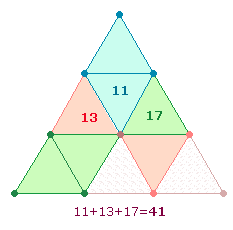
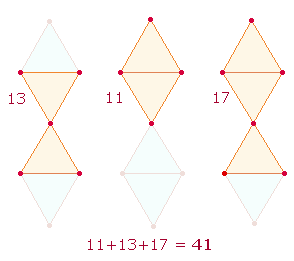
The trinitarian number 153 forms a ratio with the NS+FS of the 2 R 68, which shows that the mutual smile between Mother and
Son flows from their common and united nature. The numbers 11, 13, 17 refer to the number of elements of 3 geometrical
figures to be found both in the tetraktys and the double-rhombus:
|
|
|
10. The poet attributes great
significance to the little boy's smile. Two aspects already mentioned have to
be considered: The son has his own nature and has adopted that of his mother,
in whom his body was formed. It seems he strongly claims his life as his own at
the expense of his mother's. It's perhaps for this reason that the poet calls
upon the boy to smile at his mother in order to give her something back as his
due.
The number 378 = 14*27
suggests that his mother smiles at him first. The NS of RISU and RISERE is 135 = 5*27. If he answers her smile, he gives her 135 of his values so that the NS+FS
ratio between Son and Mother is now (621-135):(378+135) = 486:513 = 27*(
The numbers 18+19 are the NV of ST, the last two letters of the poem.
Furthermore, the NS of the last line is 18*19 = 342.
11. Also divisible by 27 are the NS+FS of
the first two + the last three of the nine words so that successive groups of 2+4+3 words come about which, assembled to the 3-digit
number 243, is 9*27.
|
|
NS |
FS |
sm |
|
NS |
FS |
sm |
|
|
|
|
|
PUER |
57 |
39 |
96 |
|
PARVE |
58 |
40 |
98 |
RISERE |
71 |
58 |
129 |
|
PUER |
57 |
39 |
96 |
PARENTI |
79 |
69 |
148 |
|
sm |
115 |
79 |
194 |
sm |
208 |
177 |
373 |
|
194+373 = 567 =
21*27 |
|||||||
The 5:4 words thus have the NS+FS
ratio 27*(
|
|
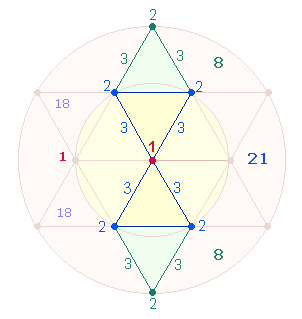
The digits 243 refer to the the middle elements of a double-rhombus:
2 crosslines, 4 triangles, 3
points. These 9 elements also apply to the two diametrical
zig-zag lines of 9 elements each so that the NS+FS result 999 shows 27 elements if the three parts are counted
separately, whereas as a united figure the double-rhombus consists of 21 elements.
Two groups
of 3:6 words provide divisibility by 9*37 = 333: the NS+FS of the words PUER (96) MATRI (108) RISERE (129).
So both the ratio of words and gematric values is 1:2.
12.
The relation of the first three lines to the last becomes clear if we
subtract 2110-999
= 1111 = 101*11. The NS+FS 605 of the last line is 55*11, together 1716 = 12*11*13.
|
|
Last entry: December 2021